la tienda, or,
the earth, fertile
with nettles and
vegetables, bringing
forth these meager
cypresses, this
black damp that
stains the walls
Words fall off the curl
Of nothing
I am involved in them
The buildings
Against myself I am
The store
The fetid nights Cannibalizing each other
Cries tumble out, taut
The debris of a revolution
We want but can’t have
It’s hard to have the fervor
24 hours a day
There’s a culmination
And a release
Like hunger like waiting
Madeline Gins worked on
An architecture
That wants to make dying Illegal
With roundness instead
Of corners
Because that’s how the Revolution must be
Round.
Let no dying
Be legal
There is something called
The reversible destiny Foundation
You can write to them
If you want
To help reverse
Your destiny.
If you don’t want
To pawn away your life
But rather to, say,
Preserve
I would say
Leave Amerikkka
If you can
Perhaps
Abandon ship for
The pleasure of a wave
“It’s not like May, this
Impure air
Spilling a mortal
Peace, estranged from
Our destinies,
Between the ancient
Walls, autumnal
May. In this the grey
Of the world,
The end of the decade
In which appears
Among ruins the
Profound, ingenuous
Effort to restore life over;
The silence, rotten and barren...
You were young, in that May
When the error was still life.
Pasolini.
It’s like he always knew
But what, exactly
We listen to the
Associative penumbra
Of things
And what do we find
A house
Sharp
In which hoping
Is not safe and dying
Is still legal.
Encouraged, actually.
An architecture of trying
To remember how
It was, being together, but Forgetting.
The material would be,
I dunno,
Water. A debt
So old that it looks new
“What the president will say and do!!:
Place all systems face down
Make all birds wear veils to look more mysterious.”
Madeline Gins wrote that
“TransP” is short for
“transformatory power”
A title for
An unpublished monument
But you know what
Linear conceptions of time
are cancelled
Starting yesterday
Waiting is trying to end me
We are all ending all the ti -
We have already all ended
All of the time.
artist statement
You walk into the room. The wallpaper is warped, peeling severely, a stained bodega-bag-brown with a hatched-textured skin. It looks as though it has been violently ripped from the wall in places, revealing layer upon layer of previous wallpapers. In some places the bare concrete of the wall is revealed like a scab. The floor is exposed scabs of concrete, a collage of rust and grey and some splotches of aquamarine. There are remnants of old, yellowed tile with floral patterns on one side of the wall, to your left. Facing you is a window. The room is bathed in yellow-toned natural light.
The room is one of many exhibition spaces within the formerly residential venue which housed Haus in Vienna in September of 2020––a small-scale, community-organized art fair. The fair organizers, in their open call, invited artists to exhibit in areas which “range from derelict living spaces (empty rooms, kitchen, bathroom etc) to garages of various sizes as well as the courtyard and the backyard.” The derelict nature of the house––whose origin story I know nothing about––announced itself as a collaborator. How to poetically intervene in this space?
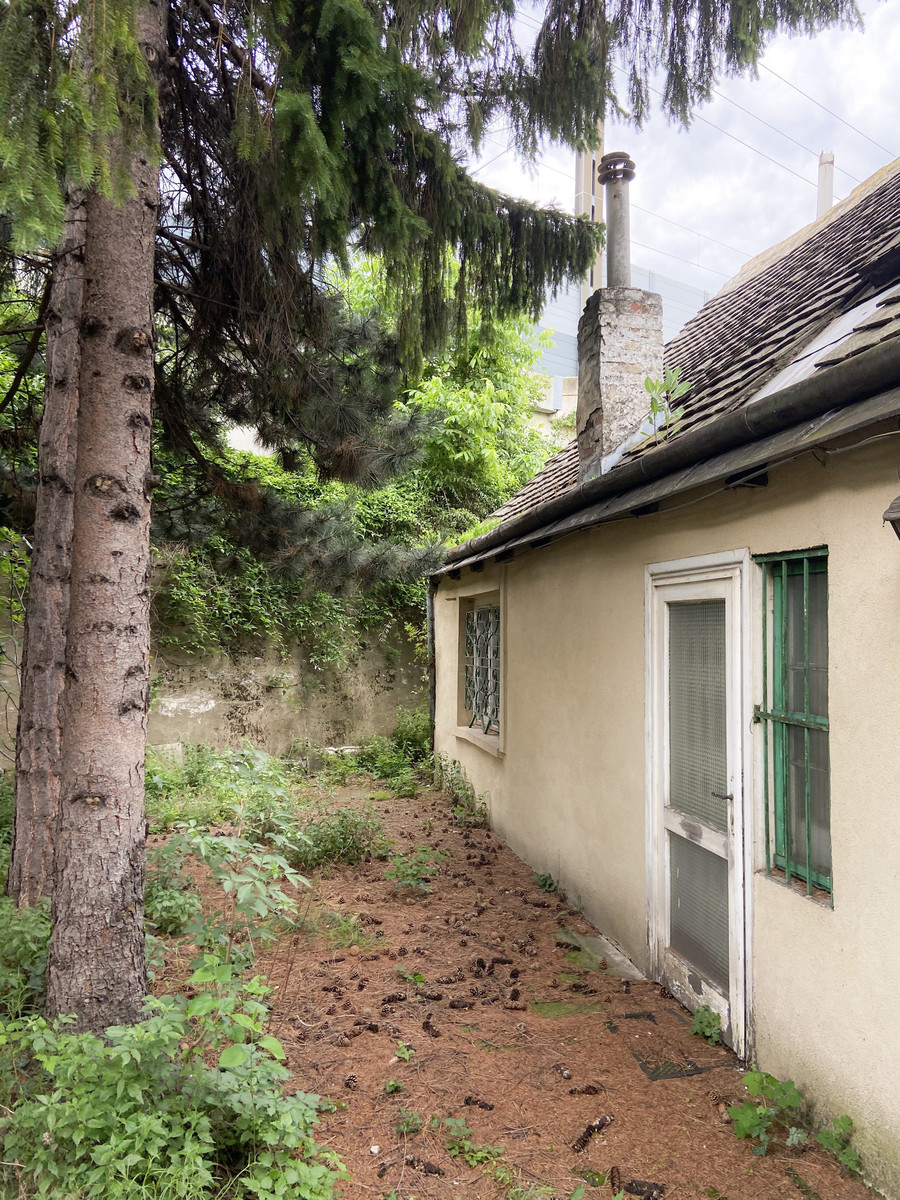
When yaby invited me to participate in a group show titled “pen pressure: a show of poetry, fantasy, and faith” for Haus, I (like many) was not leaving my own house much, it being early in the pandemic. I shuffled between house and store,store and house. While writing the poem “la tienda, or, the earth,” I was circling around these situational loci. Going to the store (la tienda), reading a Pasolini poem, watching a film. Repeat. A few months prior, Siglio Press had published The Saddest Thing Is That I Have Had to Use Words: A Madeline Gins Reader, edited by Lucy Ives. This text became another anchor.
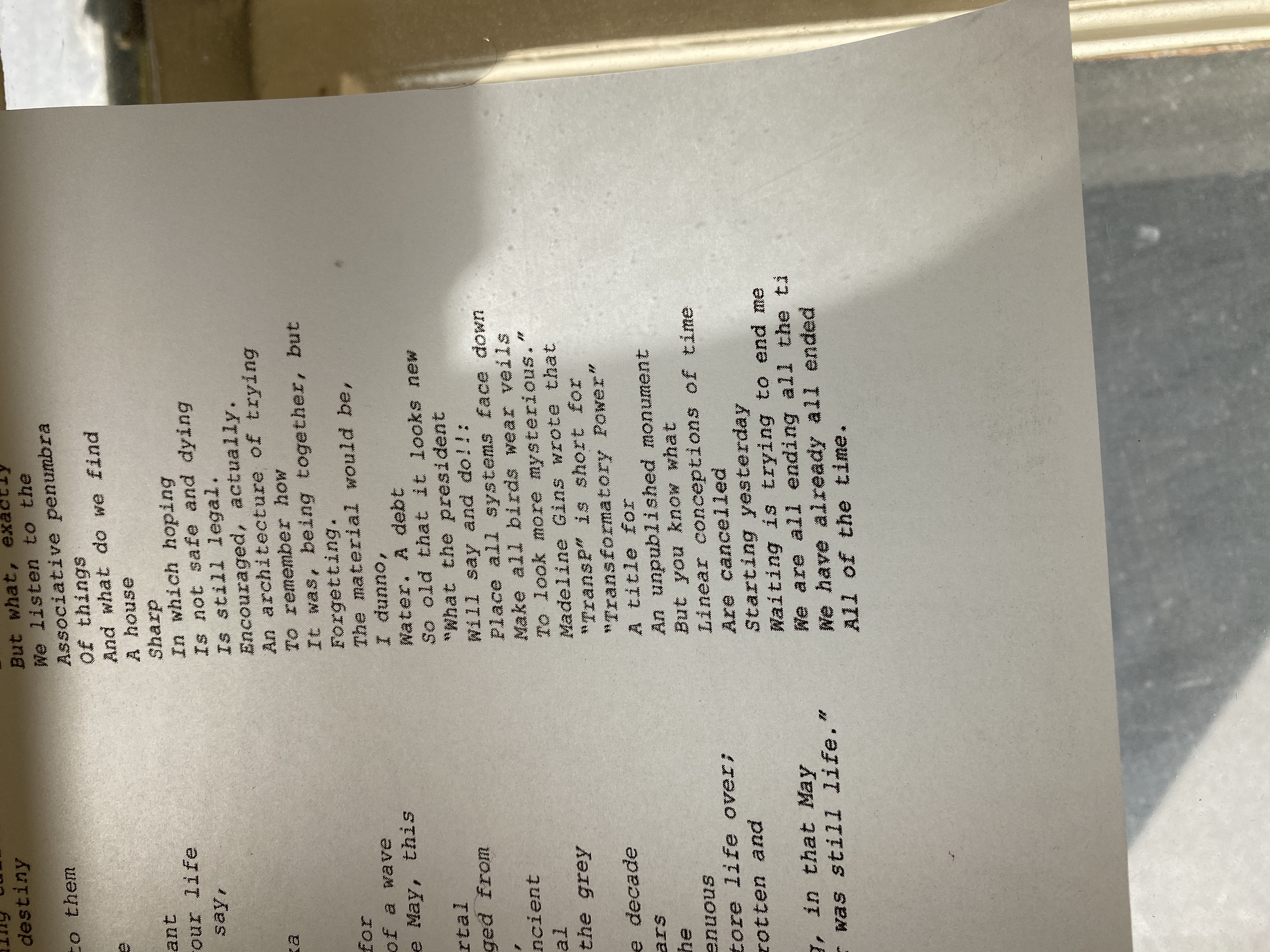
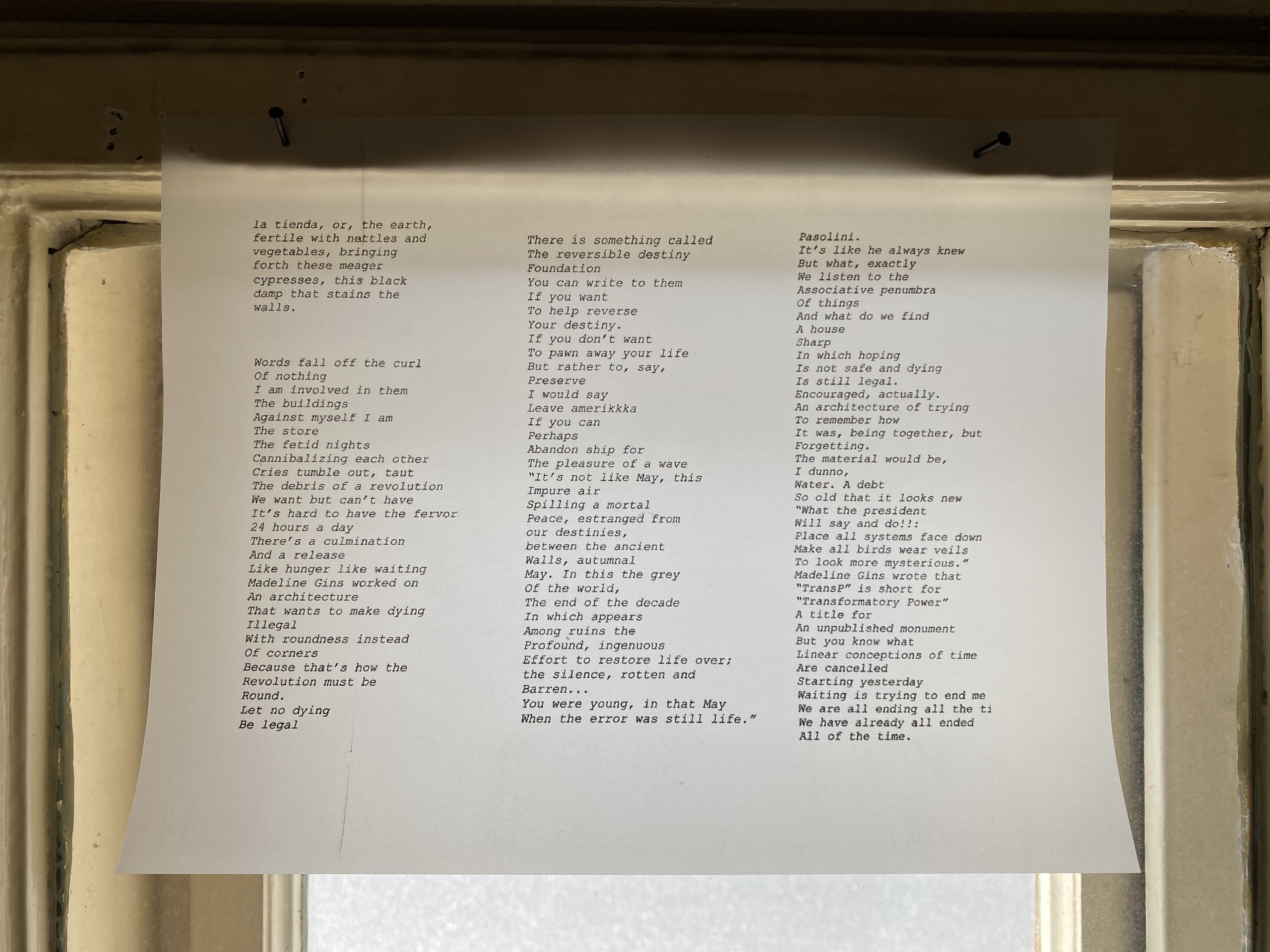
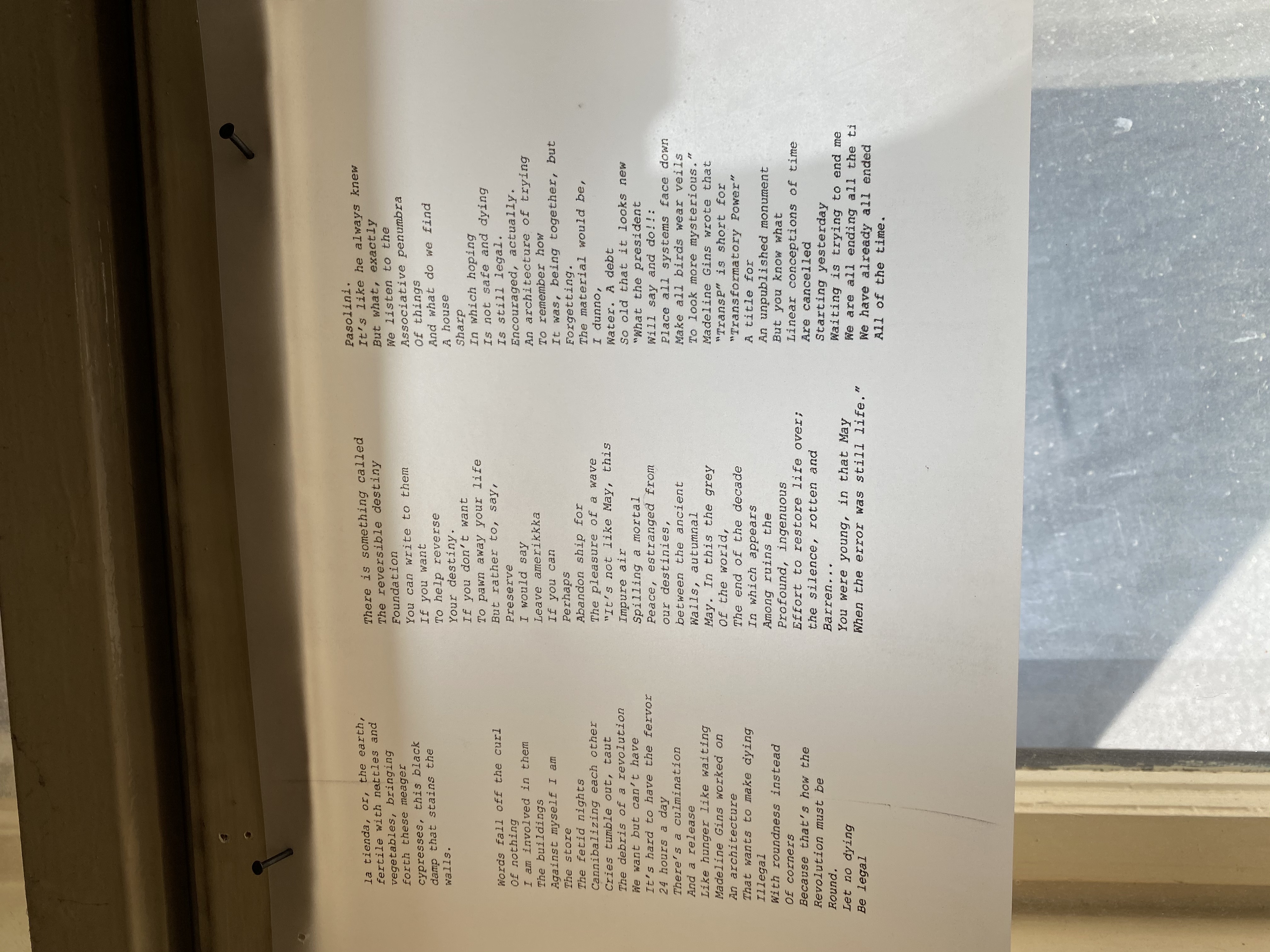
The poem emerged out of this state, and out of the desire to make something which could be transparent, like a mirror, letting the words cast themselves into new meanings. The material transfer of the poem onto vellum, humble as it is, changed something about the materiality of the words.
In the room, the light filters through the poem, diffuse. Rusty nails secure it to the decrepit molding. Decay continues.
-
Thank you to Haus and to yaby (Bea Ortega Botas and Alberto Vallejo) for including me in “pen pressure” in 2020.
Coco Sofia Fitterman is the author of Say It With Flowers (Inpatient Press, 2017) and a doctoral student in the Department of Comparative Literature at the Graduate Center, CUNY. Her research interests include: twentieth- and twenty-first century American and Latin American poetry and poetics in circulation, women in the avant-garde, experimental writing, asemic writing and illegibility, translation theory, and critical theory. She is a Poetry Editor at Women’s Studies Quarterly (WSQ) and an Events Fellow at Lost & Found: The CUNY Poetics Document Initiative. She teaches writing and literature courses at Baruch College, NYC.
Copyright © 2025 Editorial Board, Qui Parle