on the
street
- Fei Ming
Walking out to the street along which an automobile has gone,
Hence a post box alone.
The postbox lettered PO
Hence no recollection of the automobile’s number X
Hence Arabic numerals alone
The automobile alone,
The street alone,
humanity alone.
some poems
from a single day
- Fei Ming
![]()
barbershop- Fei Ming
for zhilin
- Fei Ming
I said I would write a letter to a poet south of the Long River
when I happened to see the shadow of a leaf falling from a tree in the yard
that wrote out a letter of the afternoon
I wanted to write a poem,
resembling the sun, resembling the moon,
resembling the shadows of the afternoon,
resembling the endless riverine ‘rustling of the falling leaves,’ –––––
there was no leafing through my poetic idea
it was not even two pages long
![]()
sound dust
(news from afar)
- Bian Zhilin
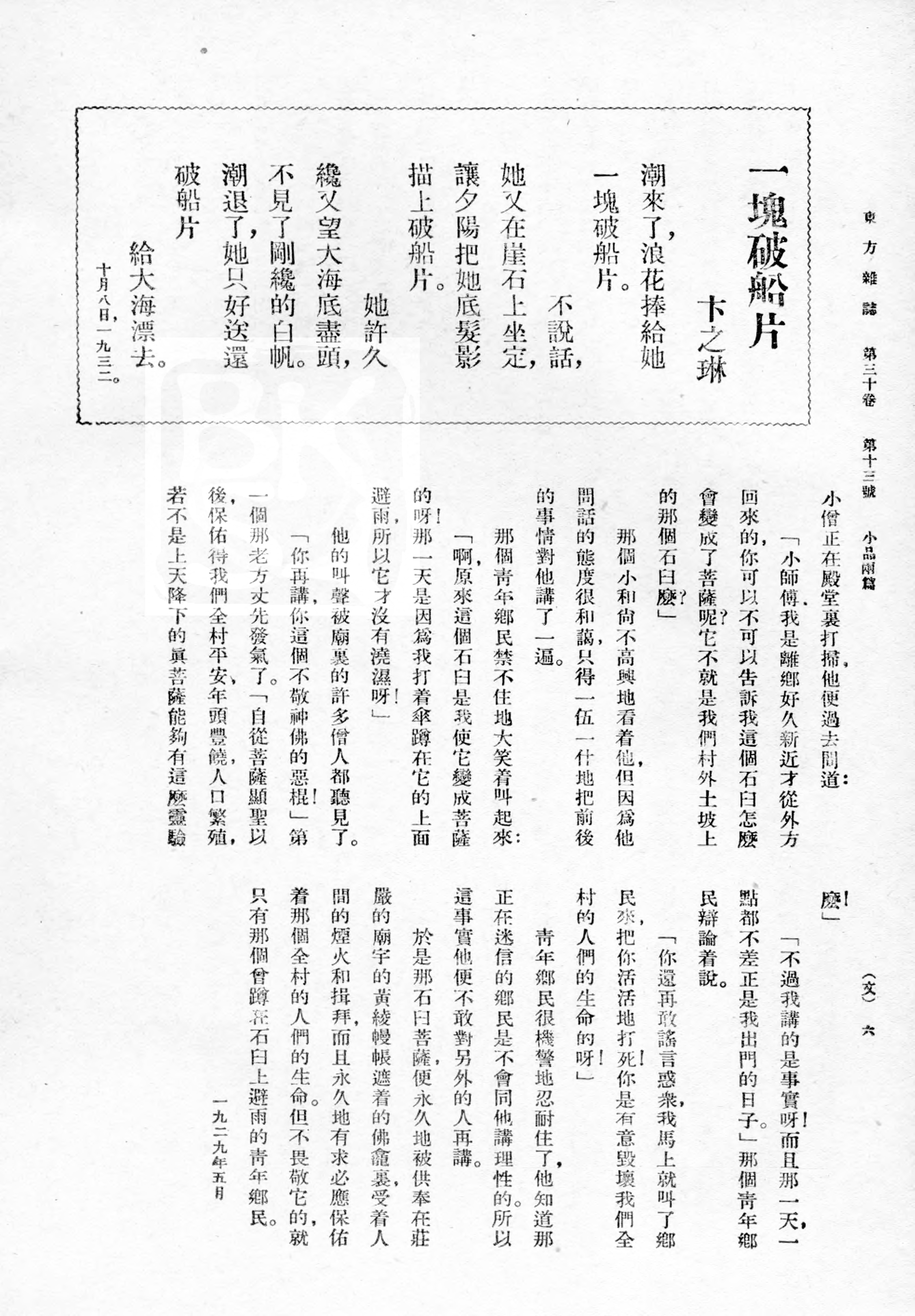
a piece of
broken boat
- Bian Zhilin
The tide comes, the sea spray throws her
a piece of broken boat.
saying nothing,
she sits down once again on the rocky cliff,
letting the shadow of the setting sun in her hair
trace a piece of broken boat.
a long while
until she looks out to where the ocean ends,
the white sail from just now that she no longer sees.
the tide recedes, and she can only send
the piece of broken boat
floating back to sea.
street
- Fei Ming
Walking out to the street along which an automobile has gone,
Hence a post box alone.
The postbox lettered PO
Hence no recollection of the automobile’s number X
Hence Arabic numerals alone
The automobile alone,
The street alone,
humanity alone.
some poems
from a single day
- Fei Ming
1. I made myself a stone and threw it
away —
Oh!
I can’t be thrown away from this world
2. I walk on the street
And
suddenly run up the mountain inside of it
I
squint my eyes, look up, and ask the blue sky:
The
realm below you behold from above is a forest after all!
3. Over such a simple matter
Because
of abnormal nerves, driven mad
4. God created everything
But
if you want to take your own life
You
will have to make yourself a knife
5. On the avenues that lead in all directions
People
look at me and I look at people
In
my heart,
I
am chanting my curse-like verses
6. At my door there is a beggar with broken legs
who drags himself along the ground
with
a rag wrapped around his knees
Would
that all of us under heaven could kneel like this before “life”,
And
see how it feels about itself then
March
16, 1930
barbershop
- Fei Ming
The foam from the
barber’s animal soap
has nothing to do
with the universe
and similarly
forgetful are the fish of the watercourse.
the blade in the
barber’s hand
remembers how humans
understand
leaving its many
marks as it cuts.
The low wireless
high on the wall starts to play,
the foamy spittle of
the soul.
for zhilin
- Fei Ming
I said I would write a letter to a poet south of the Long River
when I happened to see the shadow of a leaf falling from a tree in the yard
that wrote out a letter of the afternoon
I wanted to write a poem,
resembling the sun, resembling the moon,
resembling the shadows of the afternoon,
resembling the endless riverine ‘rustling of the falling leaves,’ –––––
there was no leafing through my poetic idea
it was not even two pages long
sound dust
(news from afar)
- Bian Zhilin
the postman in green presses the familiar door bell
pressing as well on the resident’s heart
is it a fish that has swam across the Yellow Sea?
a crane that has flown across Siberia?
“open up the map and look” says the one who is far
away.
He points out to me the place here he is at
beside the dotted line, a black dot.
if it were a golden spot
if my chair was the peak of Mount Tai,
on a moonlit night I might guess where you are
likely a lonely train station.
yet I am facing a history book.
gazing to the west as the sun sets
on the ancient road to ruined city of Xianyang,
waiting for the sound of a swift steed’s hoofbeats
a piece of
broken boat
- Bian Zhilin
The tide comes, the sea spray throws her
a piece of broken boat.
saying nothing,
she sits down once again on the rocky cliff,
letting the shadow of the setting sun in her hair
trace a piece of broken boat.
a long while
until she looks out to where the ocean ends,
the white sail from just now that she no longer sees.
the tide recedes, and she can only send
the piece of broken boat
floating back to sea.
-
Fei Ming (1901–1967)
was
a Chinese modernist author and poet, known for the obscure and eccentric beauty
of his literary style. He studied English literature at Peking University in
the 1920s, where he was associated with many of the leading reformist literary
figures of the day, including Lu Xun and his brother Zhou Zuoren. Fei Ming was later
drawn to the Yogacara Buddhist thought that had flourished for centuries in his
hometown of Huangmei, Hubei province, where he weathered the war years as a
school teacher. He also drew on the supple yet highly stylized language of late
Tang poets like Li He and Li Shangyin to create a new modern Chinese poetic idiom.
His best known work of fiction is a pastoral modernist novel in prose-poems, Bridge(Qiao). He embraced Maoism in the wake of the communist revolution in 1949, and
died of cancer at the height of the Cultural Revolution in 1967.
Bian Zhilin (1910-2000) was one of the foremost adherents of China’s modern poetry in the vernacular. He studied English and French literature at Peking University, graduating in 1933, and went on to become a celebrated translator of works from William Shakespeare, as well as of poetry by T.S. Eliot and W.H. Auden. Collections of his own poetry include Leaves of Three Autumns (Sanqiu ye, 1932) and Fish Eyes(Yumu ji, 1934). Like Fei Ming, Bian Zhilin’s poetry evinces his efforts to channel modernist notions of mind and consciousness through Buddhist and Daoist thought, and to inflect French symbolist forms with the syntactic fluidity and paratactic quality of classical Chinese poetics. Driven by the ravages of war, he taught at the makeshift Southwestern Associated University in Kunming along with other notable authors like Shen Congwen, Mu Dan, and the British literary critic William Empson. He returned to Peking University as a professor of literature after the war and joined the Communist Party in 1956.
Andrew Jones teaches modern Chinese literature and media culture at the University of California, Berkeley. His most recent book is Circuit Listening: Chinese Popular Music in the Global 1960s (Duke University Press, 2020). He has translated fiction by Yu Hua, Ge Fei, Wang Zengqi, and Fei Ming, as well as Eileen Chang's Written on Water (NYRB Classics, 2024).
Bian Zhilin (1910-2000) was one of the foremost adherents of China’s modern poetry in the vernacular. He studied English and French literature at Peking University, graduating in 1933, and went on to become a celebrated translator of works from William Shakespeare, as well as of poetry by T.S. Eliot and W.H. Auden. Collections of his own poetry include Leaves of Three Autumns (Sanqiu ye, 1932) and Fish Eyes(Yumu ji, 1934). Like Fei Ming, Bian Zhilin’s poetry evinces his efforts to channel modernist notions of mind and consciousness through Buddhist and Daoist thought, and to inflect French symbolist forms with the syntactic fluidity and paratactic quality of classical Chinese poetics. Driven by the ravages of war, he taught at the makeshift Southwestern Associated University in Kunming along with other notable authors like Shen Congwen, Mu Dan, and the British literary critic William Empson. He returned to Peking University as a professor of literature after the war and joined the Communist Party in 1956.
Andrew Jones teaches modern Chinese literature and media culture at the University of California, Berkeley. His most recent book is Circuit Listening: Chinese Popular Music in the Global 1960s (Duke University Press, 2020). He has translated fiction by Yu Hua, Ge Fei, Wang Zengqi, and Fei Ming, as well as Eileen Chang's Written on Water (NYRB Classics, 2024).
Copyright © 2025 Editorial Board, Qui Parle