weighing
of the light
After the passing of my grandfather in fall 2023, the anticipated loss of my grandmother has intensified. Reflecting on mortality as a human condition, Weighing of the Light and its related glass works begin with photographs from my personal archive, including screenshots of digitized interactions with my grandmother. These photographs are combined with fleeting moments marking the passage of time, such as a reflection of light entering a studio around the time of the funeral. Unaffected by gravity, digitized photos circulate through electronic signals. Within the compressed time and space mediated by screens, these experiences of distance are handwoven, rephotographed, and later applied to glass. Unlike humans, digitized images do not age or decay. Visual glitches and distortions emerge as photographic glass bodies slump over molds, shaped by time, heat, and gravity.
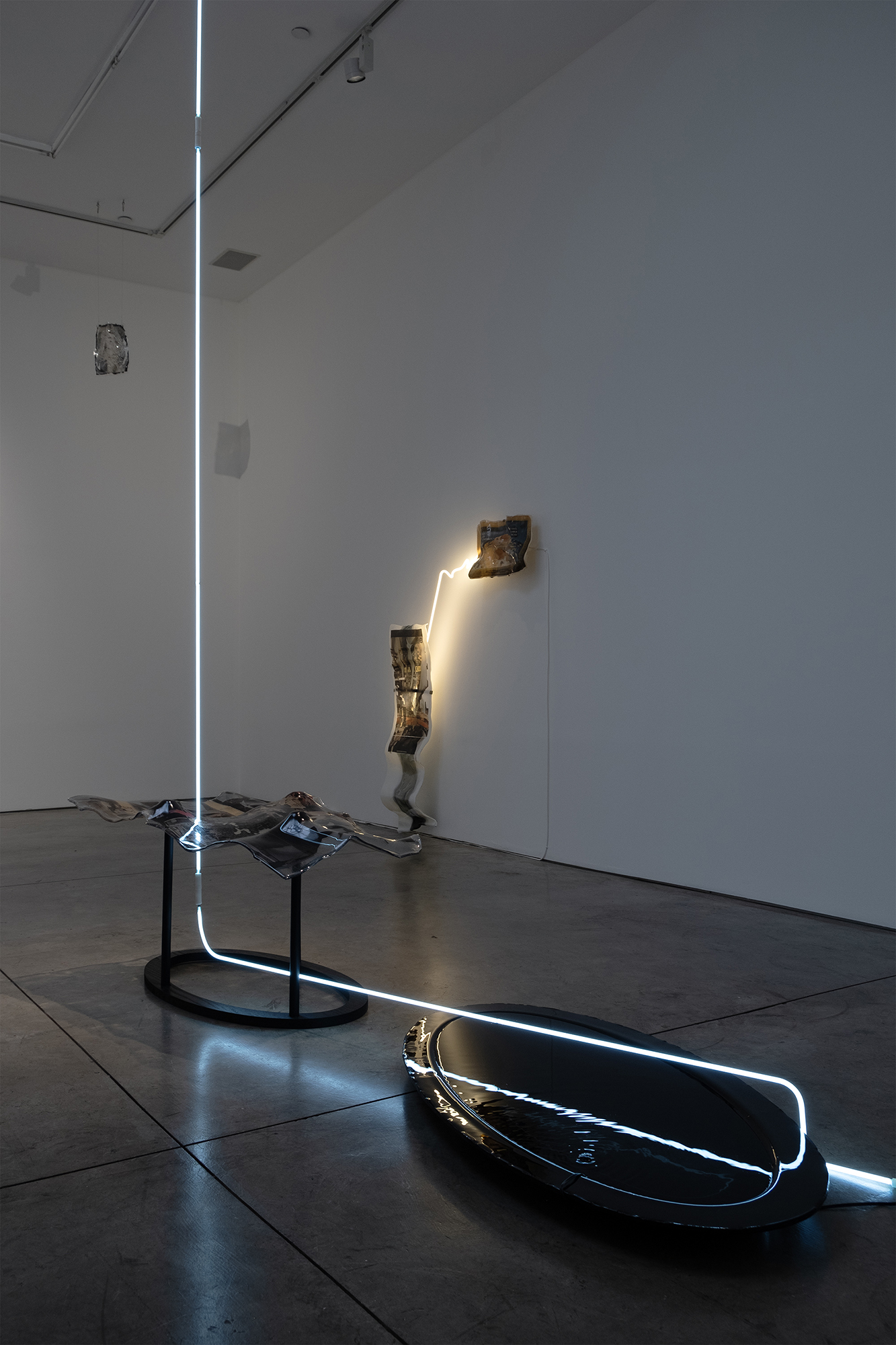
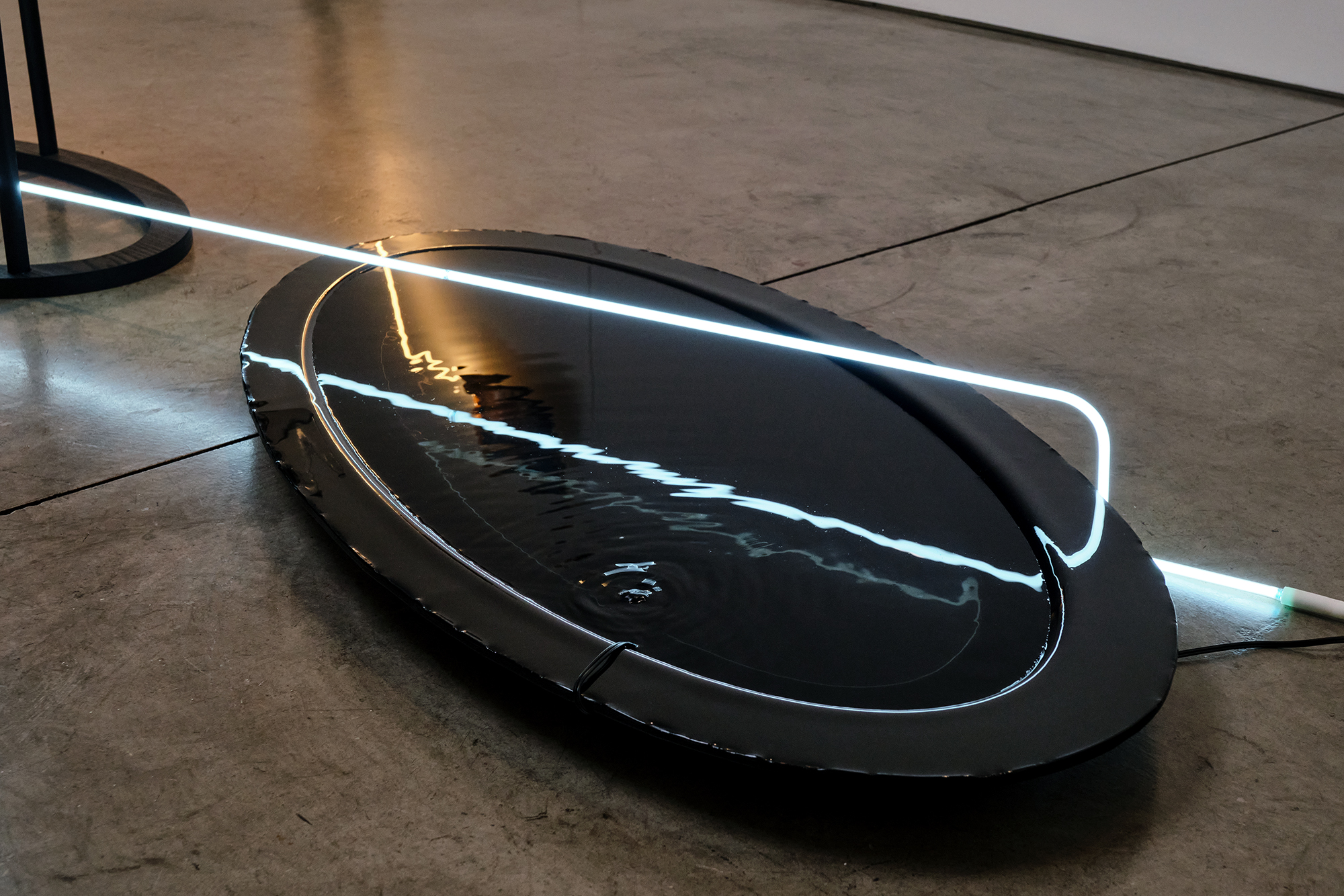
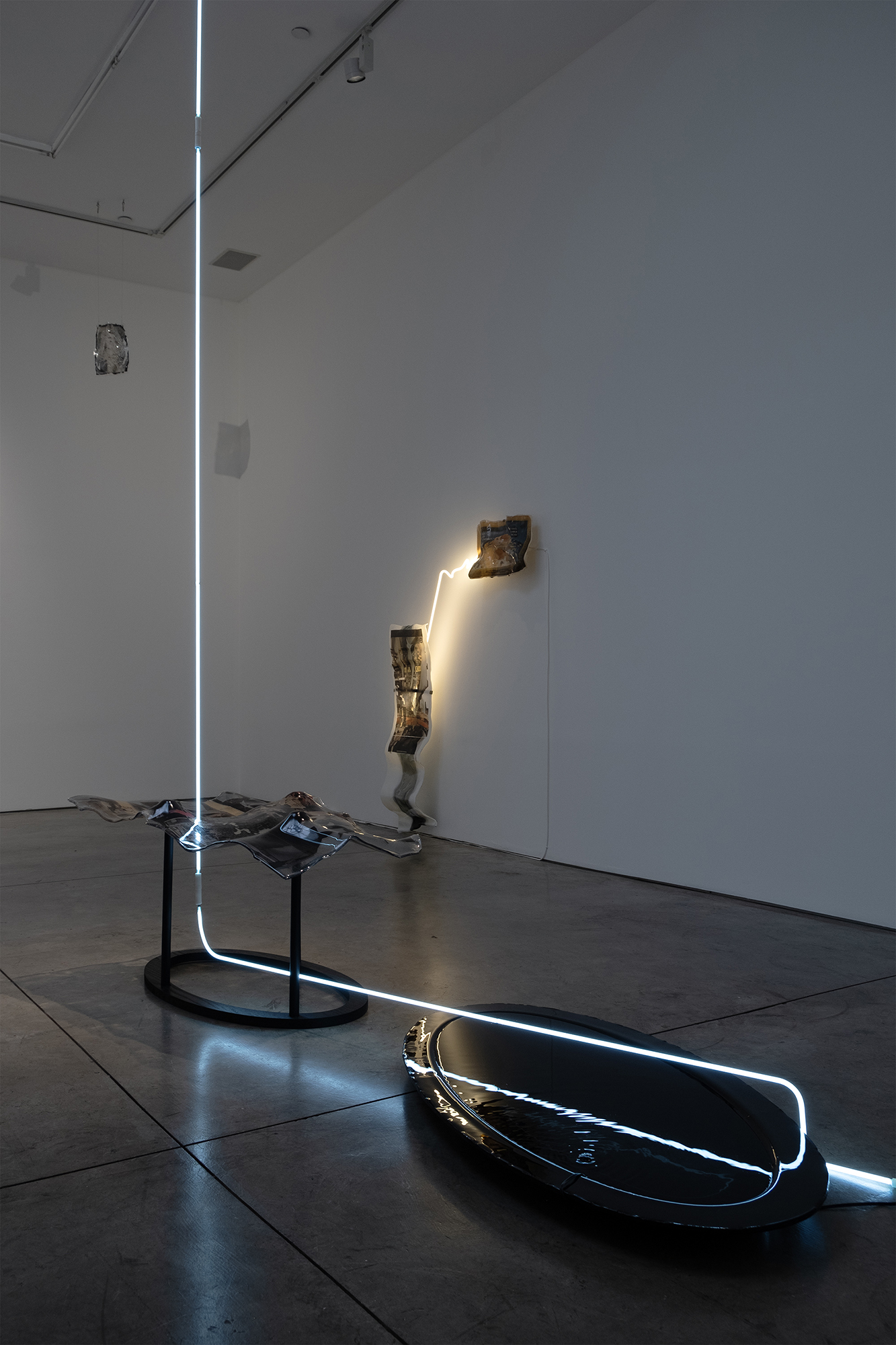
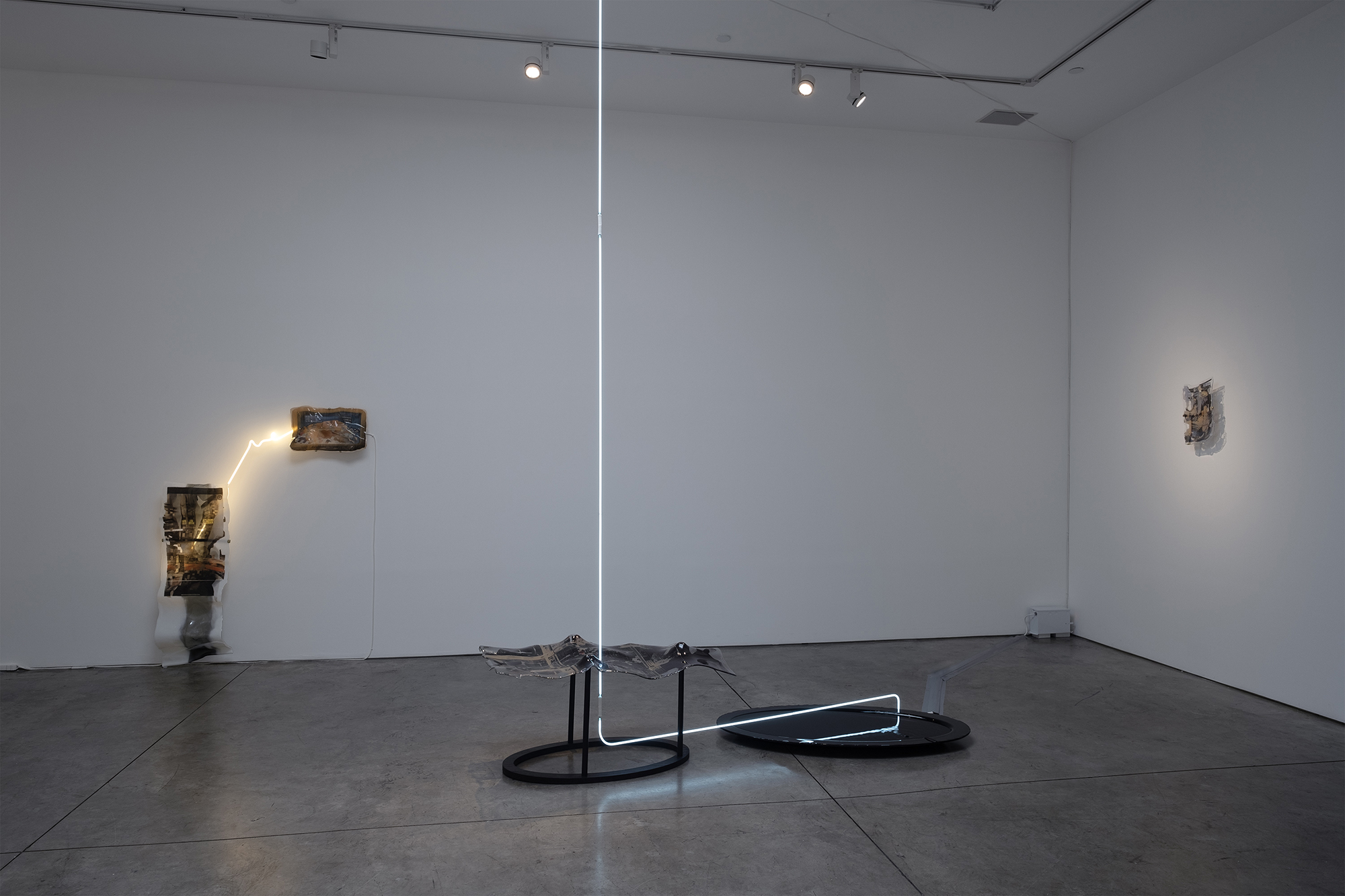
In Weighing of the Light, a black oval glass pool holds water stirred by a pump, reflecting neon that bends upward through a slumped glass piece on a black-stained wood stand. Embedded in the glass are woven photographs: the site of my grandmother’s future urn in a Buddhist temple in Seoul, a nighttime plane view over New York on her return from Seoul, and a video call screenshot of my grandmother lying on a futon. The selected photographs were initially printed on paper, spliced and woven by hand, rephotographed as woven imagery, and printed into photographic decals made compatible with the kilnforming process for glass. Each woven imagery joins two photographs, each from a specific location and time, recording an in-person encounter or a digitized interaction.
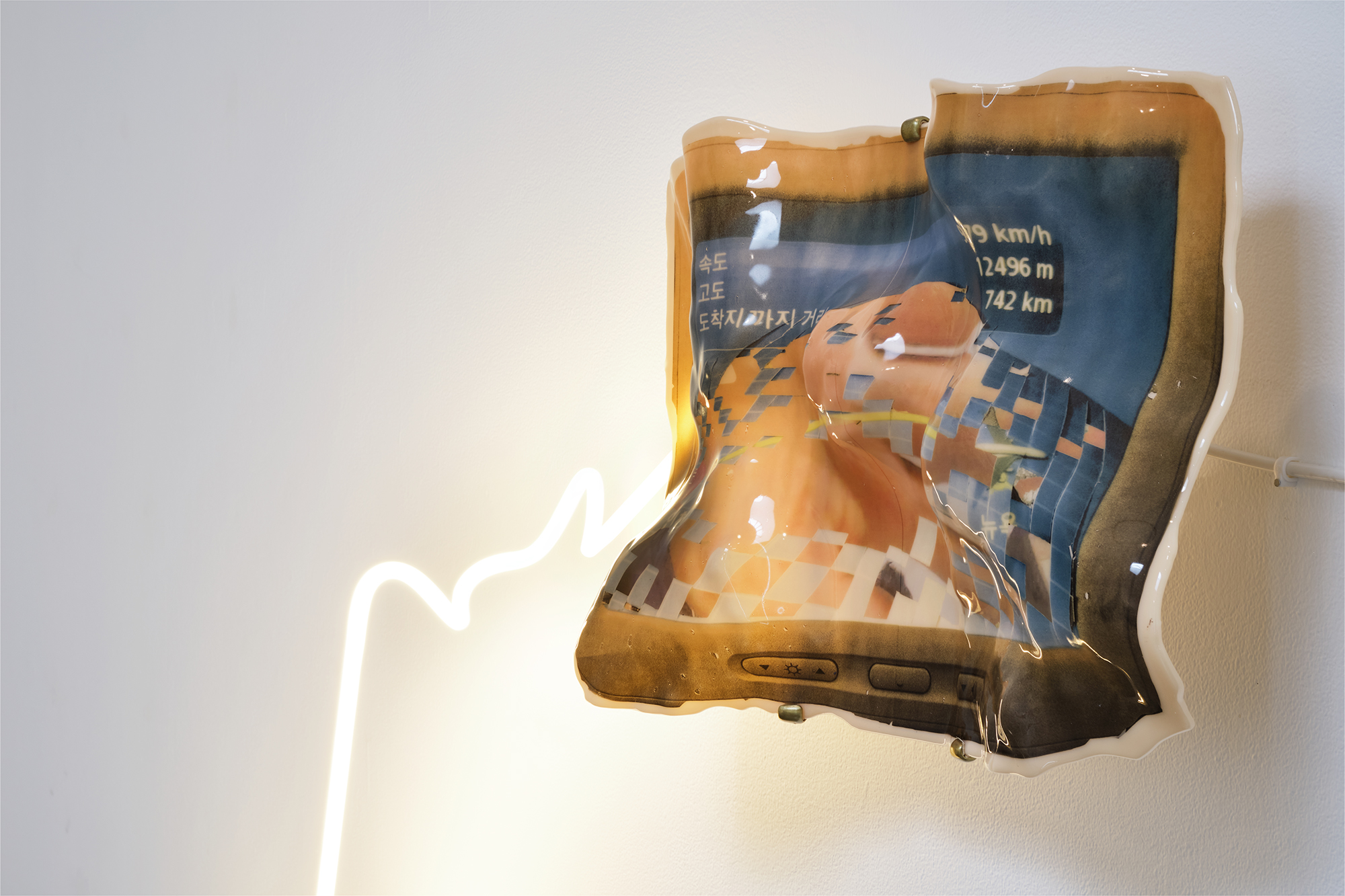
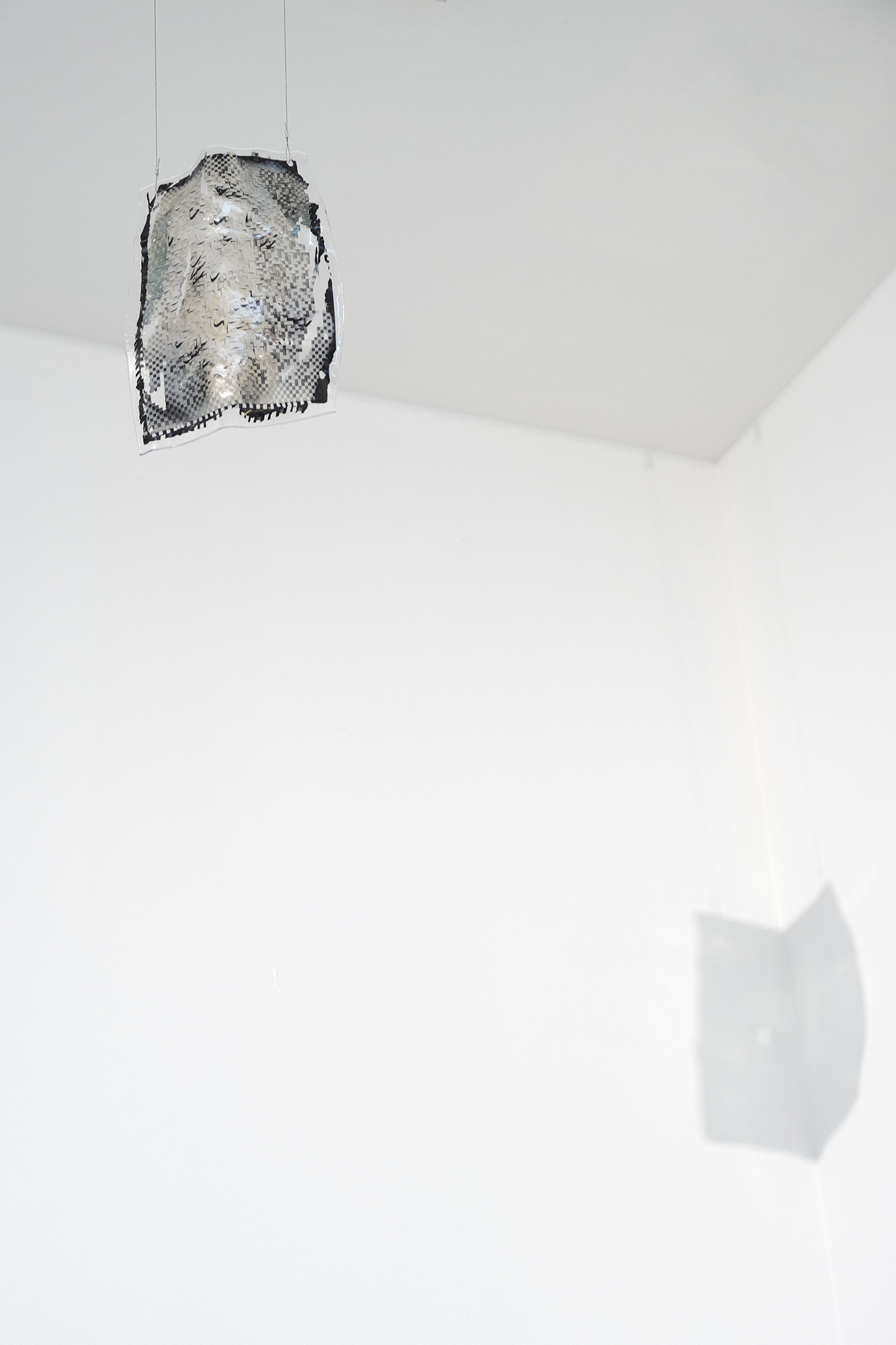
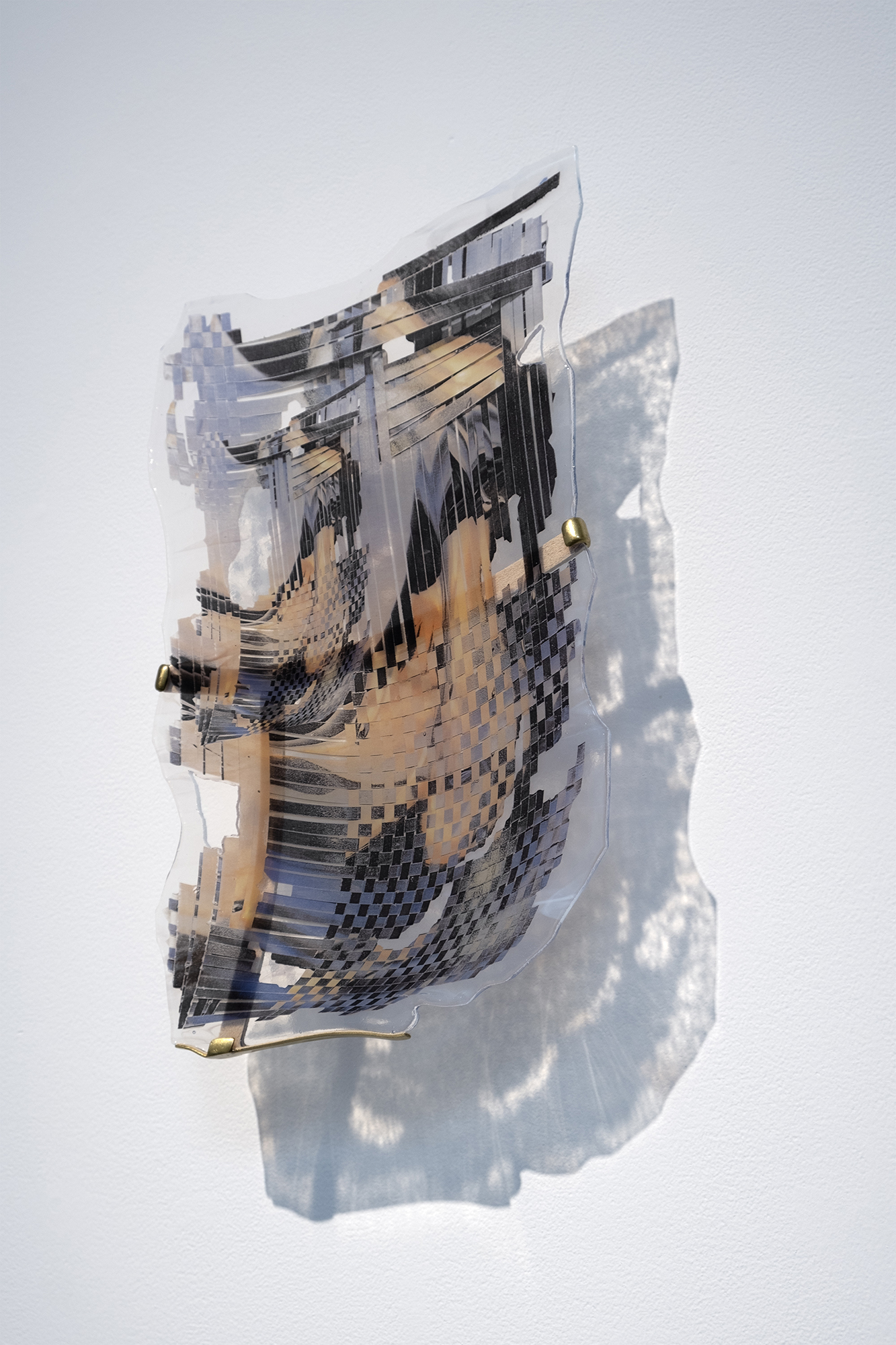
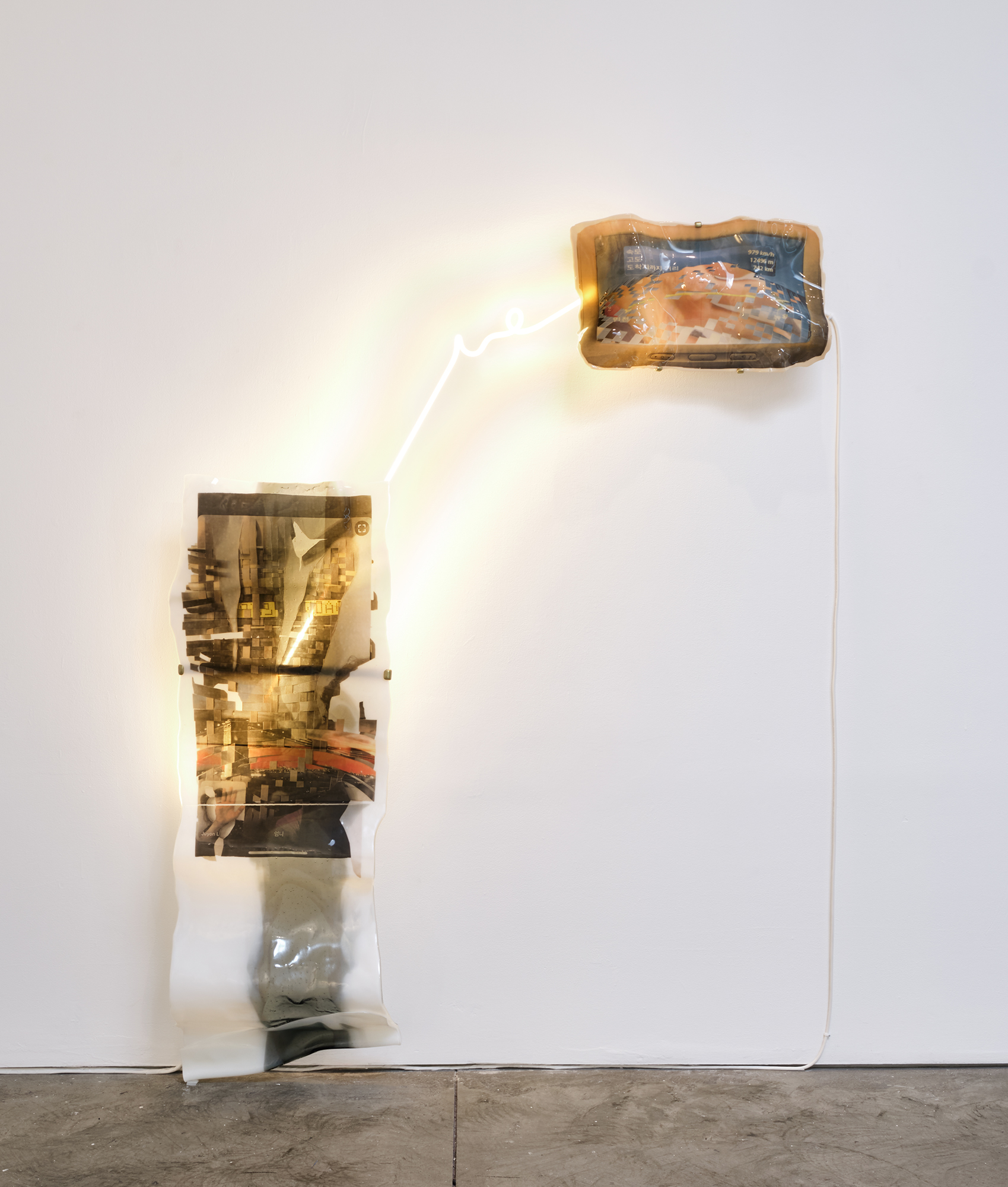
Suspended nearby, a small slumped glass piece (Woven Bodies Travels I) contains woven images of my grandfather’s body wrapped in hanji, Korean mulberry paper, for his funeral, and light entering my residency studio in Connecticut. Neon intersects and connects the components from the ground upward, or vice versa, drawing a dimensional and planar shift from the moving reflection of water near the ground to its upward reach. Where does a being go as the body nears the ground and energy disperses? What does it mean to connect to one another via the mediation of screens and electricity across the globe? How does a being extend itself through the instability of memory and time?
-
Juyon Lee is a South Korea-born artist based in Brooklyn, New York. Having grown up between Seoul and the greater Boston area, Lee developed a heightened awareness of the dissonance experienced across time and space. Composed of ethereal elements such as light and air, tangible yet diaphanous materials like glass and silk, and architectural structures, her image-based work traces how ephemerality and ontological residues, such as memory and the subconscious, converge in human experience and perception. Through layered applications of image, material, and light, her multidimensional work reveals the shifting tension between the apparent solidity and underlying instability of matter and being, embodying experiences ranging from grief to the nonlinearity of time.
Lee has exhibited widely, including Baxter St at the Camera Club of New York (2025), Episode Gallery (2025), TCNJ Gallery (2024), New Bedford Art Museum (2023), NARS Foundation (2023), and Tufts University Art Galleries (2022). She is the recipient of notable fellowships and awards, including the Café Royal Foundation Grant for Visual Art, Bronx Museum AIM Fellowship, Pilchuck Fellowship, and St. Botolph's Emerging Artist Award. She participated in artist residencies at LMCC Arts Center, The Studios at MASS MoCA, Anderson Ranch Arts Center, Vermont Studio Center, and more.
Lee has exhibited widely, including Baxter St at the Camera Club of New York (2025), Episode Gallery (2025), TCNJ Gallery (2024), New Bedford Art Museum (2023), NARS Foundation (2023), and Tufts University Art Galleries (2022). She is the recipient of notable fellowships and awards, including the Café Royal Foundation Grant for Visual Art, Bronx Museum AIM Fellowship, Pilchuck Fellowship, and St. Botolph's Emerging Artist Award. She participated in artist residencies at LMCC Arts Center, The Studios at MASS MoCA, Anderson Ranch Arts Center, Vermont Studio Center, and more.
Copyright © 2025 Editorial Board, Qui Parle