Recent Issues

Articles
Occupied Territories: An Introduction
Naima Karczmar and Joel Auerbach
In the wake of genocide, this special issue gathers critical theorizations of the Israeli occupation of Palestine with the aim of providing a basis for understanding formations of imperialism and possibilities of solidarity in the contemporary global conjuncture.
Read now at Duke University Press
The Child and the Prophet: Temporalities of Palestinian Resistance
Abdaljawad Omar
Against colonial unchilding—the stripping of Palestinian children from futurity—this article theorizes re-childing as ontological resistance in Palestinian literature. Through Kanafani, Daqqa, and al-Araj, the author argues that these writers reclaim the child as insurgent epistemology: a mode preserving wonder and prophetic imagination within catastrophe. Drawing on Benjamin’s messianic temporality, the article shows how Palestinian resistance operates through vulnerability as political faculty. The child and prophet converge as figures keeping the world open to revelation. Re-childing reorients resistance theory: to resist is to remain capable of astonishment, protecting tenderness within militancy while insisting the future breathes through language.
Read now at Duke University Press
The Last Jewish-Palestinian
Samiha Khalil
Edward Said, working through the Western interwar and postwar theoretical traditions, articulates existential homelessness/exility as a countering ideal to the rigid homogeneity of the nation-state. This essay emphasizes the need to reconfigure Said’s framework for theorizing Palestinian subjectivity within discourses privileging exility, because the theoretical space of exility itself is bound up with a Western theoretical preoccupation with anti-Semitism, Nazism, and Jewish redemption. It tangles constructions of the Palestinian as a partial, fragmented figure (archaeological, biblical, ahistorical, acultural), who lacks aesthetic capacity to travel, materially and symbolically, and thus to join the human march of culture and civilization. Beyond even these theoretical foreclosures, the current Gaza genocide exposes a need to move beyond the currently imagined basis for reconciliation, coming as it does from a specifically post-Holocaust Jewish rhetoric that universalizes the Jewish figure of the exile as a way of securing a path of assimilation and human transcendence.
Read now at Duke University Press
Immunocolonialism in the Shadow of Genocide
Kelly McGuire
This essay draws on Roberto Esposito’s immunitary paradigm to analyze how the state of Israel deploys the conceptual paradigm of immunity, biologically, politically, and legally, to maintain and legitimize its settler colonial project while shielding itself from critique and accountability for its genocide in Gaza. As a historically racialized and gendered construct in the West, immunopolitics relies on a colonial epistemology of separation and othering that maintains an impenetrable border between self and other. In epitomizing what this essay theorizes as an “immunocolonial state,” the case of Israel yields insight into the sacrificial logic of contemporary settler colonial projects and underscores the urgency of seeking out decolonial ethical alternatives to the ideologies that hold them in place.
Read now at Duke University Press
My Home of Ruins: Israel’s Ecological Violence as a Mode of Territorial Control in Southern Lebanon
Mona Khechen
This article examines Israel’s ongoing military operations in southern Lebanon as a deliberate and planned effort to obliterate life and reconfigure territory. It argues that ecological violence—understood as the disruption of human and nonhuman interrelations—is both a tactic of war and a strategy of territorial domination. The analysis explores how Israel has weaponized nature and the built environment, employing a scorched-earth policy that serves broader settler colonial goals. It also explores psychological warfare tactics aimed at demoralizing local populations and inducing displacement, alongside broader, slower, and less visible forms of violence that increase the risk of dispossession and permanent uprooting. In this vein, the article focuses on the historical and symbolic significance of the Hula Valley—originally part of Greater Lebanon—and the growing force of invisible violence embedded in nature protection narratives. In conclusion, it reflects on “eco-normalization” as a mechanism that obscures or legitimizes asymmetric power and raises broader concerns about how the politics of postwar recovery and reconstruction may entrench territorial control and displacement in southern Lebanese towns.
Read now at Duke University Press
Superfluous Labor: The Settler Colonial “Turn” in the Study of Palestine
Anonymous
No one following the critical academic study of Palestine and Israel over the past decade and a half could fail to observe the dramatic proliferation of the category of settler colonialism. This article examines the intellectual historical conceit of one prominent strand, those studies taking after Patrick Wolfe’s influential theorization. Where many scholars observe a renewal or return to an earlier tradition of studying Zionism, the author argues that recent developments represent a paradigmatic turn. This is, moreover, often a highly “motivated” interpretation that aims for the history to adhere to the preferred theoretical schema (specifically, the superfluity of native labor to the settler economy), rather than striving to incorporate the unfolding of a dynamic struggle and its contemporary analysis. To demonstrate this shortcoming, the article then samples a selection of English- and Arabic-language sources from the apparent interim in the theorization of Zionist settler colonialism. These works, responsive to their conjuncture between the June War and the First Intifada, not only deploy many concepts and theories that are illegible in the Wolfean paradigm but also demonstrate a concerted recovery of the history and struggles of the Palestinian working class and their relevance to the struggle for national liberation.
Read now at Duke University Press
Interview
A Case of Empire: An Interview with Darryl Li
Dimitri Diagne
Darryl Li is an anthropologist, attorney, and legal scholar at the University of Chicago. He has written and spoken extensively about the Israeli occupation of Palestine, beginning with his time working for the Gaza-based Palestinian Center for Human Rights from 2001 to 2002. After several years at human rights NGOs, Li shifted to academia in part to better understand the transregional Muslim social worlds targeted by the “war on terror.” His book, The Universal Enemy: Jihad, Empire, and the Challenge of Solidarity (2019), is a study of Muslims who traveled from Western Europe, the Middle East, North Africa, and South Asia to fight in the 1992–95 war in Bosnia-Herzegovina. His research across geographies informs his attentiveness to mobility and transmutability—of people, technology, weapons, and ideas.
Read now at Duke University Press
Roundtable
We Haven’t Started Yet: Workshop as Reassembly
Bishnupriya Ghosh, Laliv Melamed, Karen Redrobe, and Marc Siegel
Our reflection commences with a workshop we had planned for the annual meeting of the Society for Cinema and Media Studies (SCMS) in April 2025 centered around one question: What should teaching “Palestinian film and media” include? The original idea was to convene those with expertise/experience in the area and nonexperts who see teaching Palestine as a historical necessity in order to reflect collectively on their curriculum and pedagogies amid the ongoing genocide in Gaza. We were galvanized by an intensifying information war that complemented and buttressed the massive loss of Palestinian lives, forced displacement, and the use of famine as a weapon of war.1 We were also alarmed by the intimidation of scholars teaching Palestine in institutions across the world, with Palestinian academics in particular under constant scrutiny. At a minimum, two imperatives face media scholars in what is unequivocally an information war geared toward erasing Palestinian politics,...
Read now at Duke University Press
Cover: Hazem Harb, Peeling #4. Courtesy of the artist and Tabari Artspace, Dubai.
Volume 35.1 is available at Duke University Press. Qui Parle is edited by an independent group of graduate students at the University of California, Berkeley and published by Duke University Press.

Articles
“I Couldn’t Get Any Anger out of Her”: Fannie’s Film, Political Affect, and the Cinema of Black Reproductive Labor
Beth Capper
In a recent interview, filmmaker Fronza Woods reflected on early audience reactions to her 1983 short Fannie’s Film, a portrait of a Black cleaning woman, recalling that this audience “didn’t want to see a Black cleaning woman . . . who was happy with her life.” This essay takes Fannie’s Film’s proposition of a “Black cleaning woman who was happy with her life” as a point of departure to argue that Woods’s film offers a critical commentary on the expectations that shape the appearance of the Black reproductive worker in counterhegemonic cinema. Reading Fannie’s Film in relation to a broader archive of largely Black feminist cinema from the 1970s and 1980s that center on the (Black) reproductive worker’s affect and interiority, the article shows how Fannie’s Film interrogates the misalignment between its protagonist’s “happiness” and prominent approaches to apprehending the Black reproductive worker as a political subject.
Read now at Duke University Press
Special Dossier on Sound
On Sound: An Introduction
Be Schierenberg and Nicholas Anderman
This introduction to the special dossier proposes a way of thinking with sound that foregrounds its relational, embodied, and historically situated nature. Rejecting both sonic abstraction and disciplinary overdetermination, the authors advocate for a polyvocal, politically engaged sound studies. The introduction concludes with a brief overview of the contributions that follow.
Read now at Duke University Press
Meditations on Meredith Monk: or, Hearing the First Part of Indra’s Net for the Second Time
Alex Ullman
It’s difficult to write about the music of Meredith Monk because it, as Adam Shatz writes, “dissolves the usual markers of time, asking us to inhabit two temporal zones at once.” This essay-poem takes up the challenge by revisiting two performances of Monk’s recent work Indra’s Net (2023): at the Park Avenue Armory on October 6, 2024 and at Mills College on November 12, 2021. The piece moves fluidly between these two performances, with occasional flights into other times, spaces, texts, and contexts.
Read now at Duke University Press
Corner, Garage, and Basement: Reused Spaces and Vernacular Sounds since the Bulldozer
Peter Ekman
This essay considers three forms of American music named and forever identified with the ordinary spaces where they arose: the street corner, the garage, and the basement. It cuts critical dispositions from musicology and sound studies together with the historical study of vernacular architecture, questioning the affordances of anonymous, serialized building and landscape types to forms of dissident reuse that their designers could not have foreseen and likely would have sought to curtail. Each reciprocity of space and sound proves differently diagnostic of the racially divided American city as remade after the Second World War: downtown, through Urban Renewal’s bulldozer-led clearance and redevelopment; at and beyond the city’s edge, through the elaboration of bulldozer-graded, automobile-oriented suburban landscapes of enclosure, both above and, significantly, below ground. The essay reimagines the stadial historical geography of the American metropolis in terms of music and sound, and it reconsiders musical genre in terms of its spatial genesis. It provokes meditations on the sonic ontology of the built environment, and it suggests ways to overhear, in these resonant scenes set in train by large-scale demolition, clues to how America’s underdetermined urban forms have harbored—and may yet disclose—the forces of their own unmaking.
Read now at Duke University Press
Acousmatic Intimacies?: A Commute through Leaky Sounds
Rey Chow
With reference to examples of contemporary amateur singing performances, and drawing on sound theory, Asian studies, and affect theory, this essay continues Rey Chow’s ongoing work on sound and voice with a newer focus on questions of intimacy, alienation, the mutation of collective space, and the possible connotations of the notion of fuite (flight).
Read now at Duke University Press
Listening to Trans Sound: Bülent Ersoy, Sandy Stone, and the Dissonance of Trans Theory
Roshanak Kheshti
A deeply personal and theoretical exploration of trans sound, an expansive concept that spans gender, nation, language, and music, this essay links trans sound not only to music by trans people but also to modes of listening and orientation that are trans—meaning across, beyond, or through gender, language, and nation. The piece also unpacks the Orientalist reception of Ottoman music in Europe, where the “singing Turk” represented hypermasculine alterity, and contrasts it with Bülent Ersoy’s reappropriation of Ottoman classical music. The essay transitions into a discussion of trans dissonance, anchored in Sandy Stone’s response to trans exclusion within feminist music communities (notably the Olivia Records controversy). Stone’s concept of “posttransexual dissonance” refers to the refusal to resolve or erase the complexities and contradictions of trans identity. Drawing from acoustics, the essay defines dissonance as an “enhancement of the audible”—a metaphor for the visibility and audibility of trans presence. Finally, the article questions how trans sound is audited, suggesting that traditional listening practices may miss its nuances.
Read now at Duke University Press
The Cicada’s Deafening Tymbals: Toward a Critical Sound Ecology
James A. Steintrager
In the genealogy of sound studies, the figures of Pierre Schaeffer and R. Murray Schafer have loomed large, the former bequeathing key concepts of sound objects and acousmatic listening, the latter the idea of soundscapes. Relatively neglected have been Schaeffer’s elaboration of sonic morphology and typology, as well as Schafer’s ecological impetus. This essay returns to and links these aspects of these writers’ works, focusing on the troubling example in poetry, sound description, and first-wave sonic ecology of the “song” of the cicada to suggest how a more critical sonic ecology might be forged—one that extends what is useful in their contributions but does not rely on the implicit embraces of purity hidden in the valuation of reduced listening (Schaeffer) and the mystical praise of silence (Schafer) and that instead makes explicit the noisy grounds of auditory dissensus and the limitations of anthropocentric listening.
Read now at Duke University Press
Tropicana, Tropicana, Tropicana: An Interview with Fred Moten
Nicholas Anderman
This conversation with the poet, scholar, and theorist Fred Moten begins with the proposition that sound blurs easy distinctions between matter and thought. In this way, sound provides an opening to what Moten calls “moments of disruption, of going off the track, of accident, of rupture, of breakage.” Cacophonous sounds have long served to orient and ground Moten’s analysis of the interplay between power, blackness, and aesthetic practice. Building on this prior work, here Moten approaches sound variously as material, medium, metaphor, and method. The dialogue brings key concepts in sound studies—silence, repetition, voice, rhythm, and so on—into conversation with themes that have long animated Moten’s thought, such as refusal, excess, improvisation, and the Black radical tradition. Topics discussed include the palimpsestic nature of live performance; the metaphysics of voice; the sonic life of labor, racial capitalism, and settler-colonial displacement; Moten’s musical-poetic collaboration with Brandon López and Gerald Cleaver; and works by Édouard Glissant, M. NourbeSe Philip, John Coltrane, and W. E. B. Du Bois, among others.
Read now at Duke University Press
Book Review
Trans Antinomies
Violet Spurlock
A review of Jules Gill-Peterson, A Short History of Trans Misogyny (Verso Books, 2024).
Read now at Duke University Press
Cover: Cicada, jade, China, late Qing Dynasty (late nineteenth–early twentieth century).
Volume 34.2 is available at Duke University Press. Qui Parle is edited by an independent group of graduate students at the University of California, Berkeley and published by Duke University Press.
Articles
Form and Its Discontents: An Introduction
Yvonne Lin and Lou-Silhol-Macher
This special issue delves into the freighted and often-debated relationship between form and formlessness, and we begin by positing that formlessness as a concept arises as the result of an attunement to form. Scholars calling for a renewed attention to form often decry the political impoverishment of formlessness, which is deployed to characterize the fragmented, interstitial, liminal, immaterial, evanescent, hybrid, unstable, unruly, unbounded, shapeless, or indeterminate. Formlessness is affiliated with gaps, dehiscence, play, disruption, dissolution, disorder, failure, excess, decomposition, or “anarcho-vitalism.”1 In service of a maximalist formalism, formlessness is simply presented as form’s opposite, at times becoming a straw man to better define formalist engagements and justify the necessity to attend to form. Yet we argue that, far from leading us into the fantasized ether or magma of shapelessness at the cost of our ability to say something for the real world—an often positivist anxiety—the formless sharpens our...
Read now at Duke University Press
Poor or Pure Form: On the Political Aesthetics of the Tent
Mario Telò
The tent, the shelter of pro-Palestine protests on American campuses in the spring of 2024 and of global metropolitan marginality, is an infrastructure of the unthought, constantly under the joint attack of capital and common sense. This essay attempts to welcome the tent’s interpellation to think and experience the unthought, specifically the informe, issued every time a home-dwelling observer encounters it. For hierarchical discourses, the tent is an expression of bad form or poor form, two ordinary norm-enforcing phrases that should perhaps spur us to correct or supplement, with a punning, prepositional negativity or heuristic tentativeness, the “return to form” still informing the theoretical zeitgeist. Explicit or implicit carriers of this negativity, Georges Bataille’s informe, Jacques Derrida’s fourmis, and Werner Hamacher’s afformative are various expressions of the poor (or pure) form that the tent’s an-architectural structure embodies. The relevance of these three alterations and supplementations of form, as a word and concept, to an-architecture is exemplified through comparative discussions of two artworks (Rebecca Belmore’s From Inside and Louise Bourgeois’s Maman) and a film (Luchino Visconti’s The Leopard). Collectively, these works illuminate the aesthetico-political implications of the tent’s inclination away from verticality, placement, and solidity toward horizontality, displacement, and liquidity.
Read now at Duke University Press
Form for All: Traversing the Skins of Human Bodies and Bodies of Discourse
Tess Takahashi
Using Emma Hart’s Skin Film (UK, 16mm, black-and-white, 11 min, 2005–7), as a point of departure, this essay considers how authorial identity has circumscribed critical readings of film in ways that impose premature form on the instability of the abstract image. Skin Film’s abstraction invites us to consider how the human body, the gendered and racialized body in particular, has been made to signify as an already-known epistemological endpoint within our culture. The essay challenges the critical conjoinment of cinematic materiality, authorship, and embodiment that too often provides easy meaning to a perplexingly formless image. The essay argues that instead of rushing to assign meaning to either image or body, we should consider the skin’s dual status as both materially specific and as an unfixed text, both formed and formless, discursively overdetermined yet uncertain in its meaning. The essay puts Skin Film into dialogue with the discourses of feminist theory, critical race studies, and queer theory, all fields invested in the positioning of vulnerable bodies that have been seen as both materially irreducible and dangerously unstable. Rather, the critical act of refusing to rush to meaning, and instead dwelling on the form of what might be construed as formless, constitutes a political act that embraces difficulty, multiplicity, and uncertainty.
Read now at Duke University Pr
Excess and Formless: The Abang-guard and the Atmospheric
Amber Jamilla Musser
This essay foregrounds multiple modes of formlessness in Abang-guard’s emphasis on making the unrecognized labor of museum guarding tangible. Nestled within their hope that greater recognition might help change the political landscape is an invitation to think complexly about how questions of representation are related to those of form. This is because their work shows how the ability to perceive form often relies on submerging something else—a condition of possibility that we might describe, in turn, as “formless.” However, the essay also argues for thinking beyond an equivalence between invisibility and formlessness by examining how Abang-guard produces a formlessness that is atmospheric and engulfing, thereby shifting the affective and political registers through which formlessness is understood. Instead of focusing only on invisibilization, Abang-guard stays with the excess of formlessness, amplifying our ability to perceive the uncapturable by labor or even representation.
Read now at Duke University Press
Unable to be Titled: Form/lessness, Asian Americanist Critique, and the Destitution of Worlds
Suiyi Tang
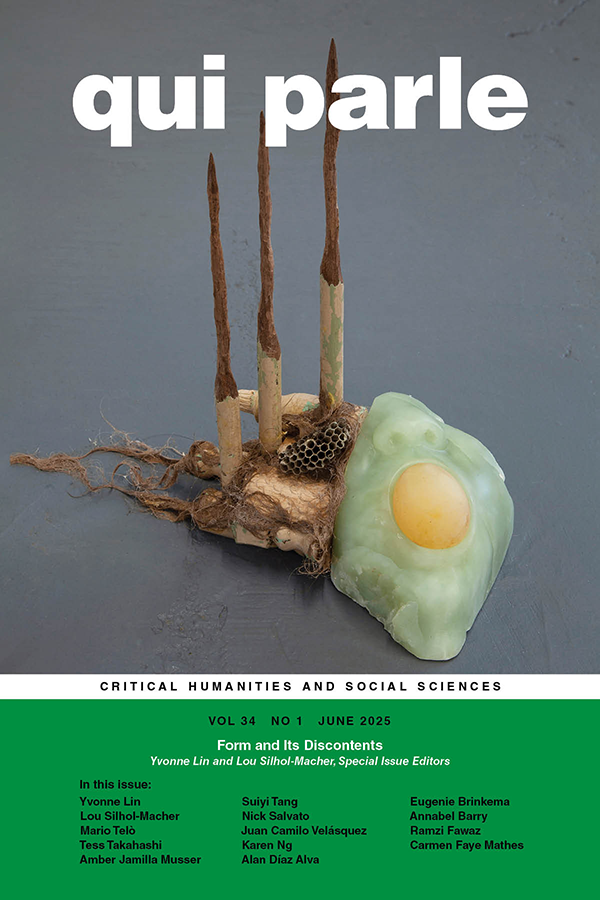
Through a close reading of it has always been the perfect instrument, an installation art exhibition by Cato Ouyang, this essay asks after the affordances of form/lessness, an aestheticization of antisociality that ruptures identitarian frameworks of belonging and exclusion. Utilizing the exhibition as a point of contact between Bataillean base materialism and Asian Americanist subjectless discourse, the essay argues that Ouyang’s sculptures invoke violent self-deformation to perform an escape from the human body and a refusal of racial abstraction. In so doing, it expands a Bataillean sensibility that calls on absolute expenditure as a means of undoing the violence of homogeneity and the settlement of form. Where contemporary theories of minoritarian worldmaking have enfolded subjectless critique into exaltations of sociality based on identitarian attachments, this essay argues that Ouyang’s work rejuvenates subjectless critique’s theoretical stakes in identitarian deconstruction, extending it to a full-fledged refusal of the fantasies of relation that in turn sustains the potentialities of social form. Is it possible, the essay asks, that the social is possible only when we work against its idealized constitution?
Read now at Duke University Press
Deformation; or, Catachresis and Silk Stalkings
Nick Salvato
This essay springs from the speculation that deformation might be a useful keyword with which to triangulate the relationship between form and formlessness—that is, with which to work yet to push against and perhaps beyond the opposition between form and formlessness. In so doing, the essay raises questions about the potential ongoing value of writing that remains indebted to poststructuralist approaches more than to recent developments in the scholarly humanities. Routing some of those questions through a figural reading of the pilot episode of the television police procedural Silk Stalkings, and the episode’s hinging on the uses of catachresis or overextended metaphor, the essay also affirms the sanguineness of tracing critical and pedagogical pathways that are not only professional but sometimes personal as well.
Read now at Duke University Press
The Intoxicating Image: Antonin Artaud and Jean Epstein’s Impossible Search for Formlessness
Juan Camilo Velásquez
In 1920s France everything seemed to be losing its form. An adolescent cinema and a burgeoning spirit of aesthetic modernism turned artists’ gazes toward the future, but the specter of Friedrich Nietzsche and nineteenth-century Romanticism lingered. This essay compares Antonin Artaud and Jean Epstein to get a sense of this intellectual milieu and its obsession with formlessness. The essay argues that Georges Bataille’s concept of informe was not the only attempt at grasping formlessness. Artaud and Epstein shared a concern with intoxication and embodied states of altered consciousness because they saw them as conduits for a fundamental state of formlessness. The essay first explores their personal and theoretical engagements with intoxication to track their intellectual influences and those whom they influenced. Then it follows their artistic quests for this elusive concept or feeling to suggest that while Epstein played with cinema to achieve a formal multitude and simultaneity that approached formlessness, Artaud rebelled against cinema and attempted to exploit the live presence of theater to approach a state of pure communion without frames or linguistic signs to separate the self from the world. Ultimately, their aesthetic experiments and theoretical interventions revealed that formlessness is a limit concept—impossible to trace, grasp, perhaps even define. Yet the elusiveness of formlessness only makes it more alluring, so much so that we still feel the hangover of the taste for it.
Read now at Duke University Press
Species-Being, Metabolism, and Natural Limit
Karen Ng
This essay explores two key concepts in the work of Karl Marx and argues for their essential interconnection: species-being and natural limits. The first section provides a general account of the idea of species-being, arguing that this concept is best understood as continuous with the post-Kantian project of “critique.” Drawing on both G. W. F. Hegel and Marx, the essay shows that species-being is connected with self-consciousness of the form of living activity and its natural limits, enabling and constraining certain theoretical and practical powers. The second section develops a distinctly philosophical account of natural limits in contrast to the empirical account generally taken up in eco-Marxist debates. This section argues that a philosophical account of natural limits provides a new way of understanding Marx’s claim that the movement of capital is limitless, or maßlos, and draws on Aristotle to develop an idea of limits in connection with purposes or ends. The third section returns briefly to Hegel and his discussion of limits to provide a more dynamic and dialectical account of natural limits, in accordance with our powers of self-consciousness and self-transcendence. These powers are enabled and constrained by our form of life, demonstrating the necessary interconnection between species-being and natural limits.
Read now at Duke University Press
Abjection and Formlessness: Value, Digitality, and the Differential Allocation of Form
Alan Díaz Alva
This article seeks to construct historical and conceptual bridges between digitality, value, and categories of social difference, understanding them as distinct yet interconnected forms of abstraction. To do so, it elaborates on Seb Franklin’s idea that the formalizing logic of capital operates through the differential allocation of form and formlessness. It argues that value-mediated sociality operates through a logic that allocates form while producing a gendered or racialized formlessness as its disavowed or abject precondition, articulating capital’s abstract domination with other forms of extra-economical dispossession and violence. The first section outlines a Marxian conceptual framework grounded on the notions of real abstraction, social form, and subsumptive form-determination. The following section explores the relation between form and formlessness, translating this dynamic into political economic terms. The third section analyzes the role of digitality, interpreting digital abstraction, in a Sohn-Rethelian key, as logically and historically linked to a form of social synthesis grounded in the exchange relation. The conclusion briefly suggests how this analysis can serve as the foundation for a critique of digital technologies that continues the Marxian critique of technological neutrality while sharply contrasting with commonly held views of digital abstraction as detached from its sociopolitical context of emergence.
Read now at Duke University Press
Interviews
The Enduring Problem: An Interview about Form
Lou Silhol-Macher and Eugenie Brinkema
For the Sake of Appearing: An Interview on the Diversity of Queer Forms
Annabel Barry and Ramzi Fawaz
Review Essay
Pattern beyond Form
Carmen Faye Mathes
A review of Sarah Dowling, Here is a Figure: Grounding Literary Form (Northwestern University Press, 2024).
Read now at Duke University Press
Cover: Cato Ouyang, font IV (2020). Soapstone base with nose and gaping mouth, stuffed with raw egg; three wooden spikes decorated with honeycomb, 5 × 6 × 13 in.
Volume 34.1 is available at Duke University Press. Qui Parle is edited by an independent group of graduate students at the University of California, Berkeley and published by Duke University Press.

Articles
What Can Dialectics Change in the System?: Yuk Hui, Marx, Vygotsky, Mamardashvili
Keti Chukhrov
This article maps the differences in the application of systems method in Marxist dialectics, cybernetics, and poststructuralism. It studies the impact of algorithmic rationality on the speculative lexicons of philosophy—especially when philosophical dialectics is defined as nothing more than quasi-cybernetic recursivity. According to Yuk Hui, the decline of philosophy and dialectics can be contested only by second-order cybernetics as the proper successor of philosophical speculation. To dispute this bold assumption, the article embarks on a comparative inquiry into the systemic method in Marx’s political economy, cybernetics, and poststructuralism, respectively. Reference to the comparative analysis of systems method and Marxist dialectics by Igor Blauberg and Eric Yudin allows one to challenge the thesis according to which the preconditions of dialectics can be developed in the frame of cybernetic recursivity. It enables one to go farther in demonstrating the differences between the Marxist application of systems, which includes dialectical procedures and genesis, and cybernetic systematics, in which these procedures are redundant. Lev Vygotsky, Evald Ilyenkov, and Merab Mamardashvili are brought in as the exemplary methodists who elaborate Marxist methodology to encompass genesis and dialectical difference within systemic abstraction.
Read now at Duke University Press
Heretical Hebrew: On Pseudoscript and Christian Humanist “Truth” in Andrea Mantegna’s Anti-Jewish Ecce Homo
Gregor Christopher Meinecke
This article discusses a Christian devotional painting by the Early Renaissance artist Andrea Mantegna. It traces its iconographic traits to illustrate its anti-Jewish implications by focusing on the depiction of an inscribed, pseudo-Hebrew paper crown. This attribute situates Mantegna’s painting within the humanist studies of Hebrew, the Veritas Hebraica, which was a means to access antique sources and to delegitimize Jewish belief. The article further draws a parallel to the burning of heretics, who wore similar crowns when they were condemned. Since Mantegna depicts the Jews with such crowns while they hold Jesus in their hands, Mantegna invents a cunning way to invert the accusers and the accused and embeds a hitherto unexplored, anti-Jewish statement. The article traces the development of the visual tradition of the ostracization of Jews in the late fifteenth and early sixteenth centuries.
Read now at Duke University Press
To FM2030
Salar Mameni
A letter to the futurologist FM 2030 written by a young martyr.
Read now at Duke University Press
Review Essays
From Automation to AI: The Informatization of Labor
Won Jeon
A review of Matteo Pasquinelli, The Eye of the Master: A Social History of Artificial Intelligence (London, UK: Verso Books, 2023).
Read now at Duke University Press
My Two Dans: Conglomeration, Criticism, and the Contemporary
Ryan Lackey
A review of Dan Sinykin, Big Fiction: How Conglomeration Changed the Publication Industry and American Literature (New York: Columbia University Press, 2023).
Read now at Duke University Press
Cover: Andrea Mantegna, The Triumph of the Virtues (ca. 1502). Tempera on canvas, 160 × 192 cm. Musée du Louvre, Paris.
Volume 33.2 is available at Duke University Press. Qui Parle is edited by an independent group of graduate students at the University of California, Berkeley and published by Duke University Press.
Articles
Introducing Ordinariness
Annabel Barry
This introduction begins with Hortense J. Spillers’s return to the ordinary in her essay “Interstices: A Small Drama of Words,” first delivered as an address at the 1982 Barnard Center Conference on Sexuality. For Spillers, recovering the vernacular language and everyday experiences of Black women unsettles the exclusions of mainstream feminist theory, yet attending to ordinary grammar means not relinquishing theoretical critique but recognizing the ordinary as itself a domain of injustice and obfuscation. By starting with Spillers, rather than Ludwig Wittgenstein, this introduction questions who counts as a theorist of “ordinary language.” It then shows how Wittgenstein’s own return to the ordinary displays an ambivalence similar to that of Spillers. For Wittgenstein, many seemingly philosophical problems are undone by noticing language as it is ordinarily used, yet the ordinary poses new problems as much as it dissolves old ones. Summarizing the disciplinarily diverse contributions to this special issue and surveying a surge of recent scholarship on the ordinary, this introduction proposes the orthogonal term ordinariness to capture the plural and diffuse way that language, people, or social, economic, and political conditions might be ordinary.
Read now at Duke University Press
From the Ordinary to the Everyday
Sandra Laugier, translated by Hannah Cox
This is a new English translation of “De l’ordinaire au quotidien,” originally published in French in 2023. In paragraph 116 of Philosophical Investigations Wittgenstein seems to outline the fundamental goal of his philosophy: “What we do is to bring words back from their metaphysical to their everyday use.” The everyday use to which Wittgenstein constantly refers is far from self-evident: it is just as elusive and indeterminate as our forms of life. The project of Philosophical Investigations is not to replace disqualified logic with the study of use, finding therein a new foundation or new convictions, even purely practical ones. The study of everyday language use presents new problems, arduous in a different way from those of logical analysis, as J. L. Austin and the Oxford School later showed—the same school that, in coining the term Ordinary language philosophy, formalized the Ordinary rather than the Everyday as a central concept. The present article considers several reasons for returning to the concept of the Everyday, Wittgenstein’s point of departure, in the philosophy of language.
Read now at Duke University Press
Wittgenstein in the Moonlight: On the Nonexistence of Riddles
Eesha Kumar
Wittgenstein’s claims against private language and the existence of riddles have consolidated his reputation as a philosopher of the ordinary. This article makes a case for Wittgenstein as a thinker of enigma. His understudied remarks on riddles configure the ordinary and the transcendent in a novel and counterintuitive dynamic. This constitutes Wittgenstein’s most significant contribution to the study of the ordinary: a demarcation between language as the domain of the ordinary and mystery as the realm of meaning. The intricate interrelationship of these realms animates Wittgenstein’s abiding interest in the “limits” of knowledge and his pursuit of finely calibrated modes of analysis. The leitmotif of the riddle leads us through an exploration of Wittgenstein’s mottled oeuvre and serves as an occasion to ponder the question of “the question” in philosophy (as a matter of discursive form) as well as philosophy’s approach to “answers.” Acts of reading and interpretation, associated etymologically with “riddling,” are imbued with a special urgency in Wittgenstein’s thought, which this article brings to bear on recent debates on surface reading and close reading. To scholars of the ordinary, this article offers a critical reappraisal of Wittgenstein’s contribution, and to Wittgenstein scholars a (perhaps unfamiliar) moonlit Wittgenstein.
Read now at Duke University Press
The Rumors Are True: Gossip in the Films of F. W. Murnau
Nicholas Baer
This essay examines the role of rumors in F. W. Murnau’s films as well as in later writings about his life and career. While Murnau perpetuates long-standing figurations of gossip as a frivolous or even malicious activity, he also grants unverified information a truth value. Where Heidegger claimed that Gerede (idle talk) is based on “groundlessness” and “indifferent intelligibility,” this essay shows that rumors in Murnau’s films are often well-founded and also essential to a nuanced understanding of his work. Bringing together film analyses, archival materials, and philosophical texts, the essay sheds light on an underexamined aspect of Murnau’s oeuvre and addresses broader questions about the status of speculative, uncertain, or contested knowledge. A study of Gerede does not entail a concealment of authentic discourse but illuminates Murnau’s philosophy of rumors as part of a dialectic of destabilized knowledge.
Read now at Duke University Press
Dead Tired
Ianna Hawkins Owen
This essay concerns the descriptions of exhaustion connected to the suicidal thoughts and actions of Anyanwu, the protagonist of Octavia E. Butler’s novel Wild Seed (1980). Expanding the disability studies concept of desirelessness to graze Black diaspora studies, this essay resists the total absorption of enslaved Black women’s suicidal thoughts and actions into the collective political motivations of the living, even as it resists their banishment. Rather than speak authoritatively about an action ultimately undertaken alone, the essay feels for the ordinary edges of the limits of “diaspora” to consider more carefully those who are lost to the collective, those who turn away from it, and those for whom suicide cannot be categorized comfortably as only resistance or defeat. Or, plainly stated: Without purpose and without pity, we can still love you.
Read now at Duke University Pre
Ordinary Expectation: Failure on the American Scene
Sean Michael Muller
Rural America is shaped by a conflicted sense of the ordinary: a place where a pastoral imagination of the countryside overlaps with, obscures, and, at times, is obscured by images of addiction and economic abandonment. This essay explores how these two senses of the ordinary are interdependent: how the possibility of a postindustrial future depends on the abjection of a deindustrial present. The essay approaches this problem through the analytic lenses of three scenes along a road known as “heroin highway” in rural New York. Tracing the ambivalence of these ordinary scenes makes it possible to see people and places excluded from the American dream as essential products of its logic.
Read now at Duke University Press
Brown Gathering: Archive, Refuse, and Baduy Worldmaking
Adrian de Leon
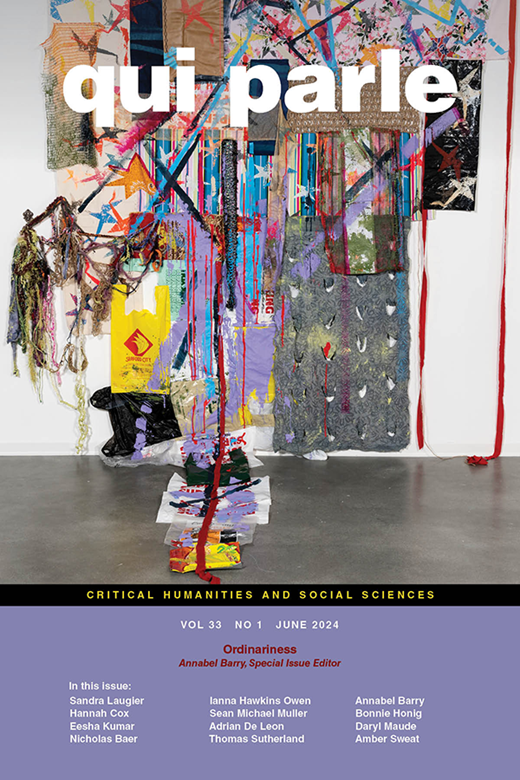
Through a sustained engagement with The Precarious Life of the Parol, an installation art exhibition by the Filipinx artist Diane Williams, this essay theorizes “brown gathering”: a quotidian practice of archiving that mobilizes the kinship networks of minoritarian subjects as an affective and circulatory infrastructure of collecting, preserving, and (re)signifying the objects of brown life. Brown gathering simultaneously attests to the intimacies of state violence and the practices of minoritarian subjects. In Parol, named after a Filipinx Christmas ornament of Spanish and native origin, Williams turns toward this curatorial practice of making art with trash objects as a way to reckon with the archival absences of Philippine history. This investigation of Williams’s pieces, all made from trash objects that her family donated to her, concerns three categories: skeletal frames (wood and wire), used to explore archives of excess and mess; plastics, used to speak about the temporality of diaspora; and discarded food containers (SPAM cans and sauce mixes), used to theorize the politics of the brown body. These objects, like the brown subjects that signify them, are testaments to the ongoing plunder of empire and to what empire jettisons around the world.
Read now at Duke University Press
The Pathos of Finitude: Ordinariness, Solitude, and Individuality in Nonphilosophy
Thomas Sutherland
Although it is sometimes construed as a mere negation of philosophical discourse, François Laruelle maintains that there is a positive side to his project of “nonphilosophy.” Often this takes the form of a defense of the “ordinary man,” a faceless individual, without qualities, defined by absolute finitude. Laruelle claims to articulate a rigorous science of man, capable of thinking human individuals in their essence, outside the philosophical interpellation to which they are usually submitted. This science intends to finally break apart the post-Kantian empirico-transcendental doublet, which is, for Laruelle, emblematic of the divided, fragmented, and alienated figure with which philosophy has always (mis)represented man. It does this by relinquishing all empirical and figural content in the name of an uncompromising formalism—a purely transcendental method. Yet, despite this intention, a preoccupation with subjective finitude, and the pathos derived from it, is both retained and amplified, describing an invariably fraught relationship between the ordinary man and the extraordinary world furnished by philosophy. Ultimately, nonphilosophy offers less a science of ordinary individuals and more an ethos for academic philosophers, guiding its readers toward a specific subject position, achieved through an ongoing labor of abstraction.
Read now at Duke University Press
Care for Language: An Interview with Bonnie Honig
Annabel Barry
This interview discusses how Bonnie Honig’s theorization of “the ordinary” has changed throughout her career, the importance of care for language in feminist thought, and Honig’s own practices of linguistic attention as an agonistic close reader of artistic and political texts alike.
Read now at Duke University Press
Review Essays
Writing with Bruised Fruit
Daryl Maude
A review of Lauren Berlant, On the Inconvenience of Other People (Durham, NC: Duke University Press, 2022).
Read now at Duke University Press
Space to Breathe
Amber Sweat
A review of Christina Sharpe, Ordinary Notes (London: Daunt, 2023).
Read now at Duke University Press
Cover: Diane Williams, Curtain of Illegibility (2020). Fabric, yarn, netting, plastic bags, ribbon, jute, acrylic, silkscreen ink on wood dowel, 204 × 84 in. Photograph by Ruben Diaz. Courtesy of UTA Artist Space. More info.
Volume 33.1 is available at Duke University Press. Qui Parle is edited by an independent group of graduate students at the University of California, Berkeley and published by Duke University Press.